|
|
|
|
|
|
|
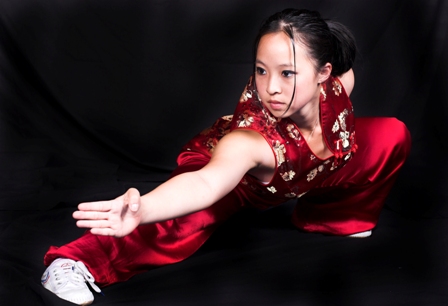
What is Wushu?
Wushu
武术 is, literally,
"the art of fighting," or “martial arts.” Westerners are more familiar with the term
"Kung Fu," which translates loosely as "skill," and was popularized by Bruce Lee movies and the TV show "Kung Fu."
"Wushu" now commonly refers to the type of Kung Fu popularized
by Jet Li and films such as "Crouching
Tiger, Hidden Dragon" and "The
Matrix". It emphasizes a clean and powerful style of
movement, and is practiced as sharply aesthetic, highly athletic
forms.
Wushu demands skill,
concentration, spirit, and consistent dedication. For those who
persevere, the rewards are great: strength, balance, and
flexibility in mind and body, and the development of physical,
mental, and spiritual resources.
Wushu has two main categories: routine exercises,
or "forms," called "taolu" 套路 in
Chinese, and free combat fighting, or sparring, called "sanshou"
散手 in Chinese. While we have taught both forms and sparring at
JING, we have recently focused our Wushu hours in the
rigorous Forms training -- stretching, kicking, jumping,
twisting, and wielding weapons large (staff, spear, pudao, etc)
and small (straightsword, broadsword, chainwhip, etc).
Learn more about our
JING Wushu Instructors and see our
Class Schedule, then come
visit.
Find out more about
Wushu for Kids and our
After-School Programs and Camps.
See fancy photos of
Wushu by our JING Performance
Team. And
read our favorite books:
The Ultimate Guide to Martial Arts Movies of the 1970s and
Awakening the Sleeping Tiger
|
|
What is Wing Chun?
JING does not currently offer classes in Wing Chun. To learn Wing Chun in San Diego, please visit Wing Chun Kuen.
Translated literally, Wing Chun
永春 means "beautiful springtime," or "radiant springtime." Wing Chun is also called "Ving
Tsun" or "Yong Chun."
Wing Chun's appeal is
due both to its simplicity and to its depth. The key idea of
Wing Chun is "economy of action implemented through the
centerline." Correct positioning, feeling, timing, and strategy
are utilized instead of brute strength, demonstrating that a
difference in skill can make up for a difference in size.
Enthusiasts of chess, music, and math are aware of how a few
well-chosen concepts can produce a wealth of expression that can
take a lifetime to explore – such is the case in Wing Chun.
Wing Chun is different from many of today's popular styles, such as Karate, Tae Kwon Do, and Kung Fu. These styles block first and then attack. Wing Chun emphasizes self-defense, focusing on methods that allow a block and an attack in the same movement. The style is based on human biomechanics rather than animal movements, using primarily straight line, fast, direct strikes and sophisticated simultaneous blocking and striking techniques, redirecting the force of an opponent rather than attempting to meet a possibly greater force directly.
The way the art produces efficient fighters in a relatively short amount of time is by sticking to several core principles and by taking a very generic approach to techniques. Much training time is spent cultivating "Contact Reflexes." The student practices guarding various zones about the body and deals generically with whatever happens to be contacted or touched in that zone. This allows for a minimum of technique for a maximum of application, and for the use of an automatic or subconscious response.
Wing Chun kung fu
teaches people how to defend themselves using practical and
efficient fighting applications, including short-range power
generation for close-range fighting, and using opponents' force
against themselves. Students develop sensitivity for the
movements of their opponents, and therefore quick reactions and
reflexes. Wing Chun also trains students' strength and structure
so that they can easily and efficiently execute clean and proper
techniques.
To learn Wing Chun in San Diego, please visit Wing Chun Kuen.
|
|
What is Bujinkan?
JING is honored to house Bujinkan
Taka-Seigi Dojo | San Diego. The centerpiece of BTSD|SD training
is Bujinkan Budo Taijutsu and Shinken Taijutsu.
Bujinkan Budo Taijutsu is a collective of nine classical schools
of Japanese warrior arts. These arts were used by the families
and clans of feudal Japan to build and maintain a power base.
The schools of the Bujinkan represent a rich tradition and
heritage of victory. They enabled the warriors of the past to
survive in society. These schools are the roots of many modern
discourses such as Aikido, Judo, Karate, and Ju-Jitsu.
Shinken Taijutsu can be interpreted as a school of modern
warfare. Shinken Taijutsu was formed from Shinkengata (real
combat methods, originally developed by Takamatsu Soke and then
refined by Hatsumi Soke), the Taijutsu of Bujinkan Budo Taijutsu,
and the modern applications of many combat methods. In 1997,
through Menkyo Kaiden, Shinkengata was given to Shihan Legare
for the purpose of further developing it to be relevant in the
21st century. Shinken Taijutsu is taught by Shihan Legare on a
seminar basis.
In a nutshell, if you think of Samurai and Special Forces;
swords, spears, and firearms; striking, grappling, leaping, and
rolling; strategy and tactics; philosophy, scholarship, and
warriorship; then you are on target.
For more information, please visit
the website of
Bujinkan Taka-Seigi Dojo | San Diego.
|
|
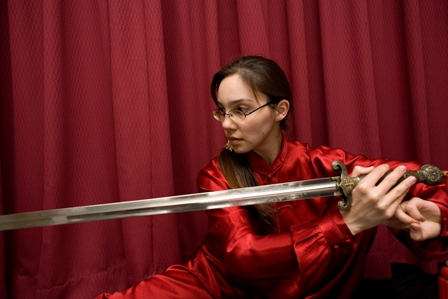
What is Taiji?
Tai Chi 太极 translates as "the supreme ultimate." In Chinese philosophy, Tai Chi is the mother of Yin and Yang. It is the theory of opposites, the positive and the negative,
the full and the empty.
The underlying philosophy of Tai Chi is that mind, body,
energy, and spirit must be unified for wholeness and complete health. The
martial philosophy of Tai Chi is to channel potentially destructive energy (in the form of a kick or a punch) away from one in a manner that will dissipate the energy or send it in a direction where it is no longer a danger.
Taiji is practiced as a gentle and
graceful, yet intense, exercise; Tai Chi emphasizes continuous movement,
alert relaxation, solid stances, a straight body, and the movement of chi,
or energy, throughout the body. Taiji is well known for
its many health benefits, including improving strength, balance,
and flexibility; improving overall cardiovascular health;
improving daytime alertness and night-time sleep; and easing the
symptoms of as fibromyalgia.
At JING, we are proud that all
students undergo solid foundational training in Taiji, building
strong legs and coordinated movements that will serve them in
practically all aspects of life, from running marathons to
blowing glass to multitasking in the kitchen. We are also
very proud of our curriculum, which allow students to slowly and
methodically learn all the major styles, forms, and weapons of
Taiji in a rational, tiered set of classes.
Here is a short list of the some of the
great Tai Chi we teach in San Diego:
Modern and Combined Forms
9-Form Beginner
Tai Chi Fist (Taijiquan)
24-Form Tai Chi Fist (Taijiquan)
42-Fist
Tai Chi Fist (Taijiquan)
48-Fist Tai Chi Fist (Taijiquan)
32-Tai
Chi Sword (Taiji Jian)
42-Tai Chi Sword (Taiji Jian)
Tai Chi Broadsword
(Taiji Dao)
Intermediate
Tai Chi Fan (Taiji Shan)
Wudang Tai Chi Sword (Taiji Jian)
Single-Style Forms
Traditional
Yang Style Tai Chi (Taiji) 40
Traditional
Yang Style Tai Chi (Taiji) 108
Beginner Sun Style Tai Chi
(Taiji)
Sun Style Tai Chi (Taiji) 73
Beginner Wu
Style Tai Chi (Taiji)
Wu Style Tai Chi (Taiji) 45
Beginner Chen
Style Tai Chi (Taiji)
Chen Style Tai Chi (Taiji) 36
Chen
Style Tai Chi (Taiji) 56
Chen Style Tai Chi (Taiji) Sword
Push Hands
Yang Style Tai Chi Push-Hands
Chen Style Tai Chi Push-Hands
Learn more about our
JING Taiji Instructors, see our
Class Schedule, then come
visit. See fancy photos of
Taiji by our JING Performance
Team. Learn
about our
Great-Grandmaster, Professor Li Deyin.
Read about JING's own "28-Form
White Crane Health Exercise".
And read the definitive book of Taiji:
Taijiquan, by Li Deyin
|
|
What is Bagua / Pa Kua?
Bagua 八卦(also known as
Pa Kua) is, arguably, the most circular, refined, and complex of
all martial arts. Bagua comprises one of the major 3 internal styles of China
alongside Xingyi (Hsing-I) and Taiji (Tai Chi). As with these
other 2 internal styles, the practice of Bagua generates Qi
(internal energy) for both health and combat purposes.
From the book Dragon
Stretches its Claws: An Illustrated Manual of Bagua Zhang, by
Liu Jing Ru and CS Tang,
“Move like a
dragon; Swing about like a monkey; and Change postures like
an eagle.
“Make steps as if
you are wading through mud; Twist both hands as if you are
twisting a rope; and Turn about as if you are turning a
stone mill.”
Named after the mystic
Eight Trigrams (Ba Gua), an ancient system of divination,
Baguazhang (Ba Gua Palm) is a martial art that employs subtle
movement, explosive power and a unique form of maneuvering.
But Baguazhang is more than just a martial art. Its elegant and
balletic yet powerful forms build strength, coordination, and
flexibility, while its traditional postures and exercises
enhance Nei Gong (Inner Strength).
The most distinctive
trait of Baguazhang is that its movements imitate Taoist
circle-walking, and twisting and circling are the norm. Bagua movements
are intended to be smooth and co-ordinated, with the body
employed as a whole. Reliance is not placed on the use muscle
power generated from a single portion of the body, rather the
source of power in Baguazhang is the Dantian, (considered the
body's Qi centre located in the lower part of the abdomen two
inches below the navel).
Bagua practitioners
also practice with many weapons, ranging from small concealed
weapons to oversized broadswords. Training with these weapons
help teach the practitioner about the proper linkage and
internal balance, as well as how to use the weapons effectively
and, perhaps more importantly, how to defend against them.
JING does not currently hold group classes in Bagua, but we welcome you to train in Wushu and Taiji to build your foundations; and then, when our Bagua coaches deam you ready, you can schedule private lessons. Please call
858-578-8267 or email
info@JINGinstitute.com
to begin!
|
|
What is Qigong /Chi Kung?
Again from the
wonderful website
www.vivalachi.com:
Qi 气 or Chi is one of
the most difficult of all Chinese concepts to comprehend. The
literal meaning of Qi is “breath” or “air”, and by extension,
“breath of life “, “life force” or “energy that sustains living
beings”. The Chinese believe that the flow of Qi governs nature
and life.
For more and much more
detailed information about Qi and Qigong, and to schedule
classes or healing sessions, please visit the Dr.s'
website,
www.vivalachi.com.
For Moving Meditation, where we
practice Qigong from the outside in, please join one of
our Taiji classes.
Read about
Developments in Qigong and
Acupuncture Research.
|
|
© 2001-2024
info@JINGinstitute.com
9865 Businesspark Avenue, Suite D, San Diego, CA 92131
Phone
(858) 578-8267 |